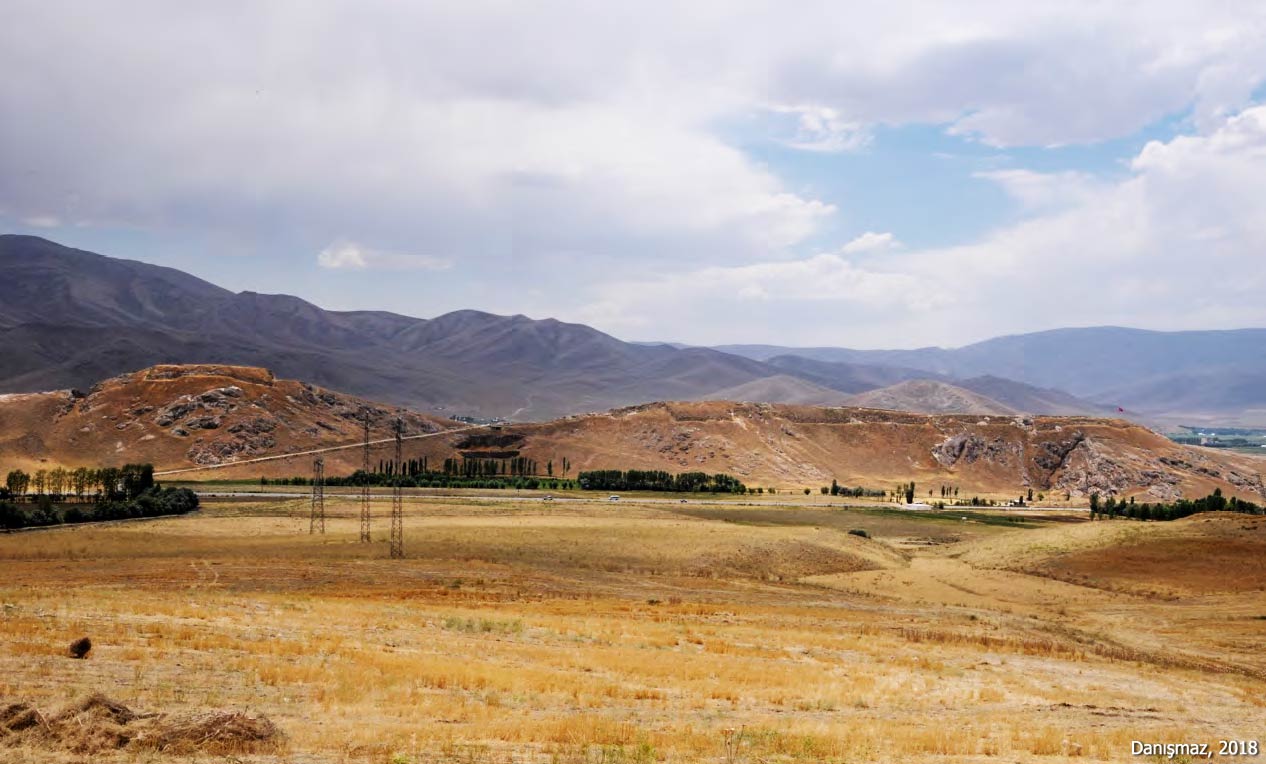
Çavuştepe fortress was founded in the mid-8th century BCE by King Sarduri II during the peak of the Urartian Kingdom’s power. Inscriptions found within the fortress refer to the settlement as Sardurihinili. The site is located approximately 25 kilometers south of modern-day Van, situated in the center of the Gürpınar Plain. The fortress was built on a 1.5-kilometer-long ridge on the western extension of the Bol Mountain range, which runs in an east-west direction.
The fortress was constructed on two hills of the ridge—one rising 110 meters and the other 90 meters—referred to as the “Upper” and “Lower” fortresses, which are connected by a shallow saddle of land. To enhance defense, 10-meter-wide moats were dug into the ridge at the western and eastern ends of the settlement.
No evidence has been found of earlier settlements predating the Urartian occupation on these hills. However, a nearby mound located 3.5 kilometers to the southwest suggests human habitation in the Gürpınar Plain dates back to the 3rd millennium BCE.
The first research at Çavuştepe was conducted between 1898 and 1899 by Lehmann-Haupt. The initial excavations began in 1961 under A. Erzen, and archaeological work at the site continues to the present day.
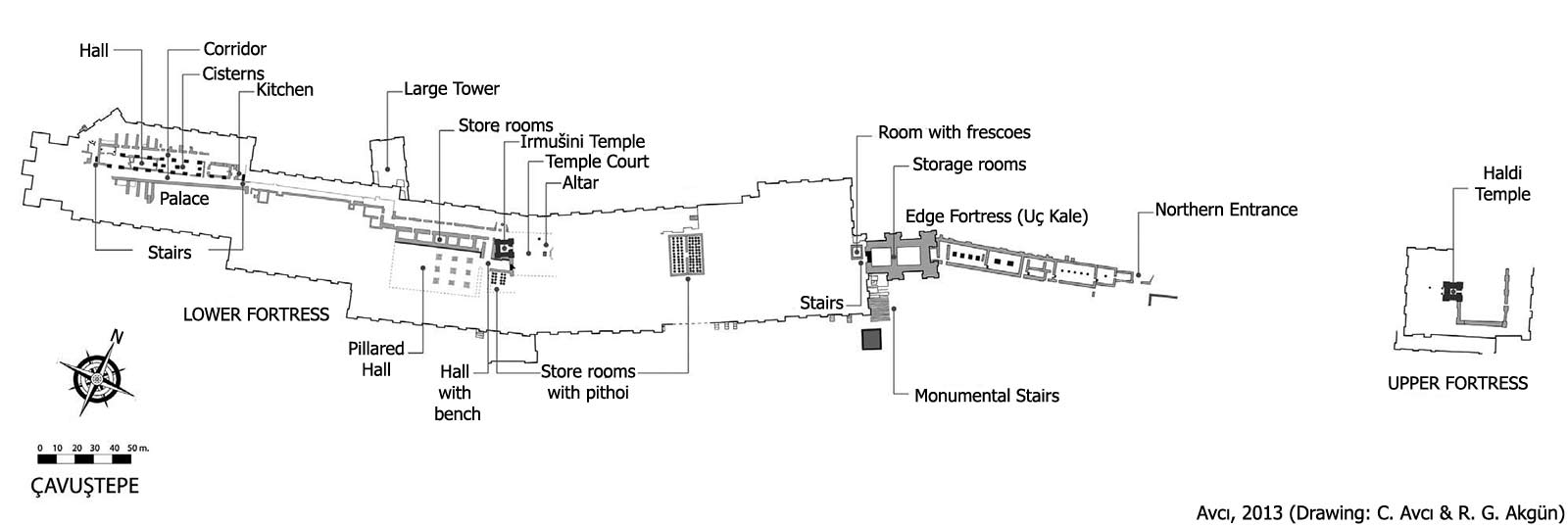
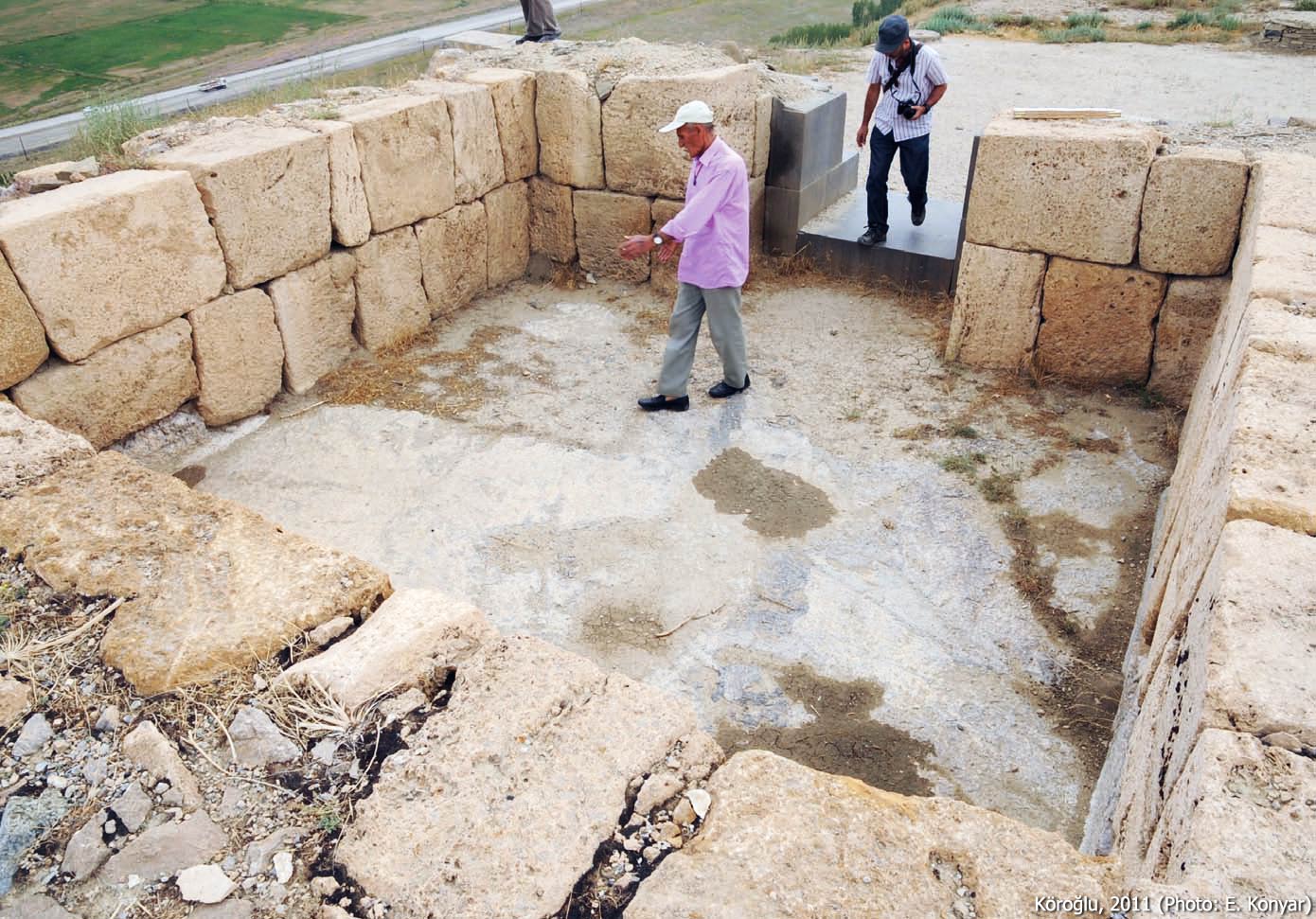
The smaller, eastern Upper Fortress was designated as a sacred area and contains only a temple complex. Enclosed within walls measuring 92 by 61 meters, the complex includes of a temple dedicated to the god Haldi and a forecourt carved into the bedrock in front of it. However, the remains of the temple and surrounding walls have been significantly damaged over time, primarily due to a medieval village that was later built over this area.
In contrast to most Urartian cities, a second temple was constructed at the highest point of the Lower Fortress, which stretches 450 meters in length. An inscription at the temple entrance (A 9‑17) reveals that it was commissioned by King Sarduri II in honor of the god Irmušini. This deity, mentioned only in the 19th position in the list of Urartian gods on the Meher Gate inscription, is believed to have been a local god worshiped by the regional population.
The largest structure in the Lower Fortress is the palace, located to the west of the Irmuşini temple. Measuring 81 by 33 meters, it is estimated to have had at least two stories. At the far eastern end of the Lower Fortress stands a structure identified by researchers as the “Edge Fortress” (Uç Kale). While Erzen praised its masonry and wall construction techniques, he also noted that the structure lacks any direct parallels in known Urartian fortress architecture. The exact function of this building remains unknown.
Excavations conducted between the Edge Fortress and the Irmušini Temple revealed another significant structure—a storage facility. Within this building, 116 large storage jars (pithoi) were discovered, partially buried in the ground, indicating the building’s use for storing provisions.
In the inscription at the entrance of the Irmušini Temple, King Sarduri II not only claims to have constructed the city and its temples, but also states that he commissioned the construction of a canal to supply water to the region. This canal, fed by the Gugunaini River (modern Hoşap Stream), still remains in use today and runs just along the southern slope of the hill.






References:
Avcı, C. 2013. “Sardurihinili Kenti ve Yeni Değerlendirmeler,” in Tarhan Armağanı (Fs M. Taner Tarhan), eds. O. Tekin, M. H. Sayar, E. Konyar, İstanbul, 37–53.
Erzen, A. 1968. “Van Bölgesi Çavuştepe Kazısı,” TTK Belleten XXXII/127, Ankara, 412–418.
Erzen, A. 1978. Çavuştepe I, MÖ 7.-6. Yüzyıl Urartu Mimarlık Anıtları Ve Ortaçağ Nekropolü, Türk Tarih Kurumu Basımevi, Ankara.
Çavuşoğlu, R. 2019. “Çavuştepe Urartu Kalesinin Van Turizmine Katkıları,” in IWACT 19, eds. F. Alaeddinoğlu, S. Şahin, H. Arslan-Kalay, S. Özer, Çanakkale, 142–149.
Danışmaz, H. 2018. Arkeolojik Veriler Çerçevesinde Urartu Krallığı’nın Eyalet Sistemi, Yayınlanmamış Doktora Tezi, İstanbul Üniversitesi, İstanbul, 2018.
Köroğlu, K. T. 2011. “Urartu: Krallık ve Aşiretler / Urartu: The Kingdom and Tribes,” in Urartu: Doğu’da Değişim / Transformation in the East, eds. K. Köroğlu & E. Konyar, İstanbul, 12–54.
Sevin, V. 2012. “II. Sarduri’nin Büyük Eseri Sardurihinili Çavuştepe”, Aktüel Arkeoloji 30, 118–121.
Sevin, V. 2014. “Çavuştepe Aşağı ve Yukarı Kale Kapıları: Urartu Mimarlığında Sıra Dışı Uygulamalar,” in Armizzi (Fs Engin Özgen), eds. E. Atilla, B. Helwing, B. Uysal., Ankara, 227–235.
Tarhan, T. 2004. “Uç Kale: Çavuştepe -Sardurihinili’nin Gizemli Yapısı Kral Kültü Tapınağı,” 6. Uluslararası Anadolu Demir Çağları Sempozyumu, Eskişehir Anadolu Üniversitesi, 115–136.
Tarhan, T. 2021. “Sardurihinili-Çavuştepe,” in Archaeology and History of Urartu (Biainili), ed. G. R. Tsetskhladze, Colloquia Antiqua 28, Leuven, 497–591.
Image sources:
KVMGM-KTB
K. Köroğlu, 2011
C. Avcı, 2013
H. Danışmaz, 2018
Bora Bilgin, 2024
Ertuğrul Anıl, 2024
Tayfun Bilgin, 2024